
Proven impact across AI strategy, cloud, and engineering
Real-world examples of how we help companies build scalable, high-performing digital systems.
Explore selected case studies across AI, cloud, and product engineering — organized by industry. See what we built and what changed.
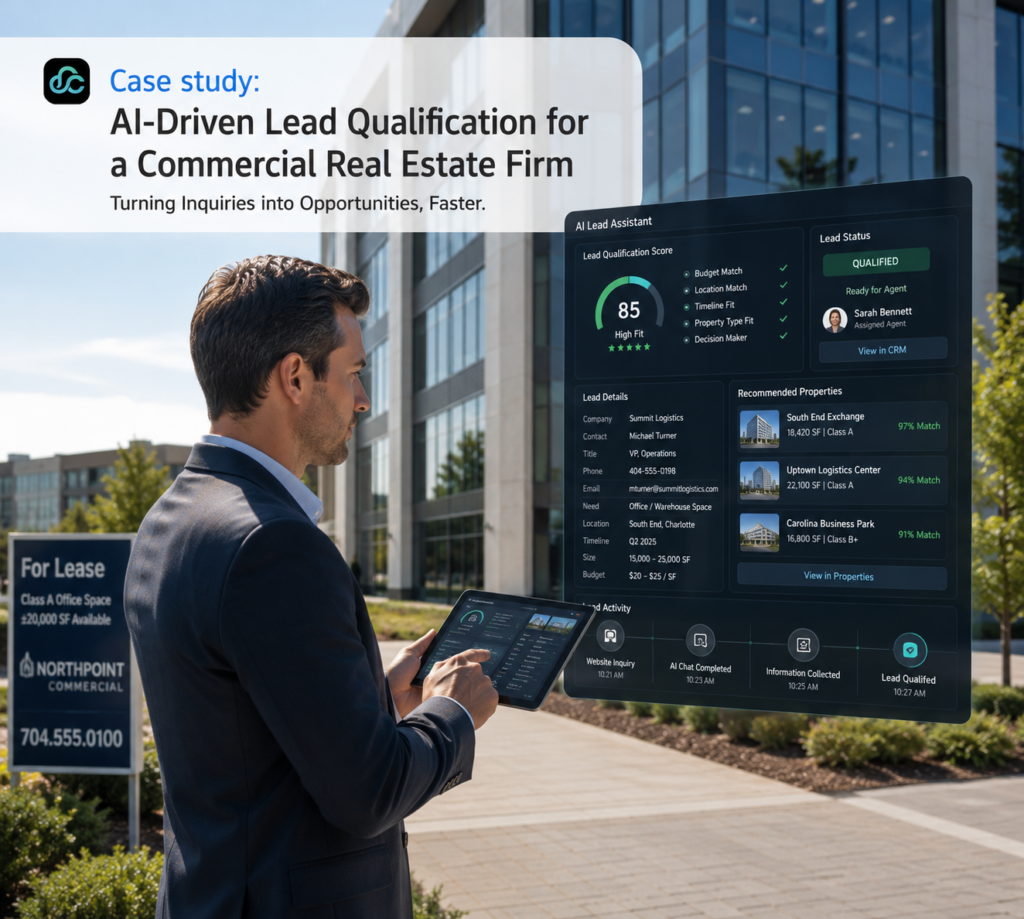
AI Lead Qualification — Commercial Real Estate
AI Lead Qualification for a Commercial Real Estate Brokerage: From Hours to Seconds on Every Inbound Inquiry
<3 Min
Lead Response Time
↑17%
Qualified Leads
Challenge
The brokerage’s average lead response took 5 hours. About 38% of inquiries were unqualified, and only 55% of leads had complete CRM records.
Slow qualification pulled brokers away from selling and made timely follow-up difficult.
The goal was faster qualification and cleaner CRM data without changing the team’s existing tools.
Solution
We built an AI assistant that responds across web chat, email, and SMS.
It qualifies prospects against the brokerage’s criteria, matches live listings, and routes ready buyers to brokers with a brief.
The system writes conversation details back to the existing CRM. Read the full case study for the rollout and technical approach.
AI & IT CONSULTING
REAL ESTATE
AI Customer Support — Regional Home Services
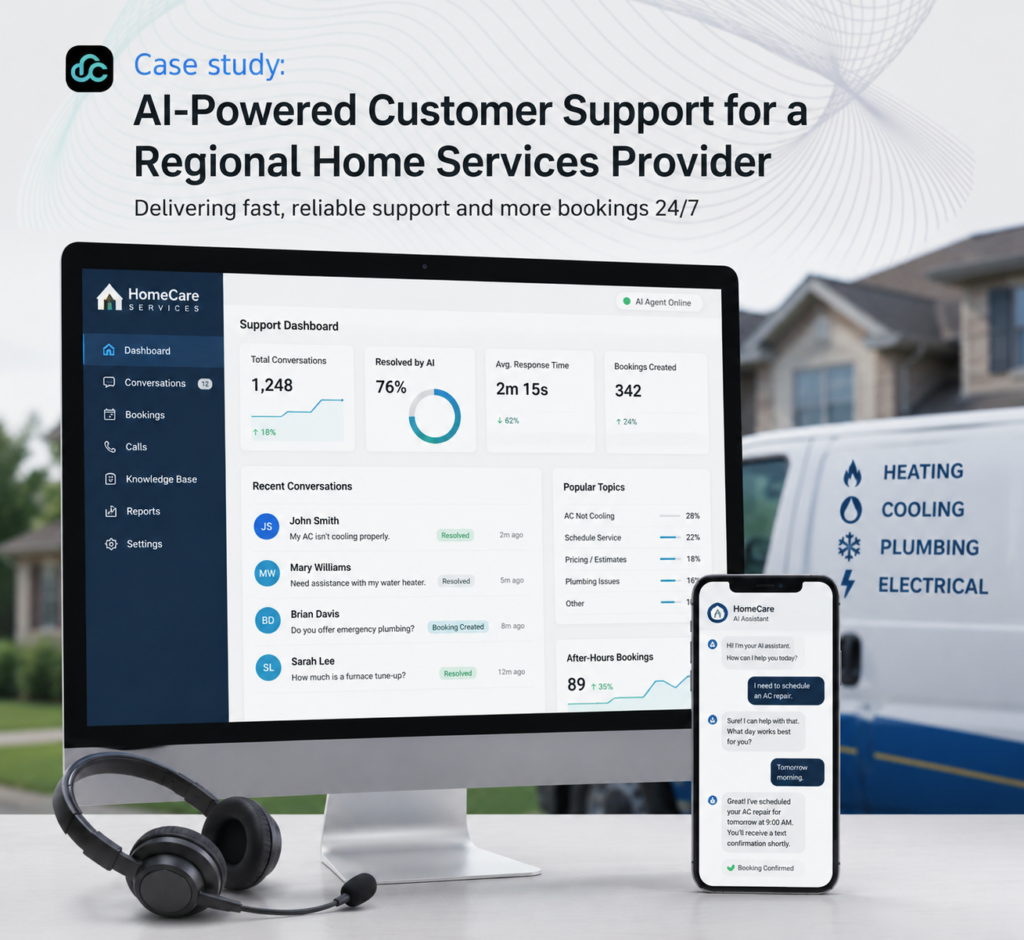
24/7 AI Customer Support for a Regional Home Services Provider: Capturing the Calls That Used to Go Unanswered
150+/Month
After-Hours Bookings Captured
65%
Inquiries Resolved by AI
Challenge
A regional home services provider in the Midwest ran a dispatch team sized for an average week — and their weeks were anything but average. A cold snap or a storm could multiply call volume overnight.
During peak season, hold times reached 11 minutes and 24% of inbound calls were abandoned before anyone picked up. After 6pm, calls went to voicemail: an estimated 85 emergency service requests per month arrived outside business hours and were never converted. Customer satisfaction sat at 3.8 out of 5, and the dispatch team was burning out on repetitive scheduling questions that never should have reached a human.
Adding headcount for a seasonal peak meant carrying that cost through the trough.
Solution
We built a 24/7 AI support layer that answers on the first ring, every hour of the year, and knows the business as well as a tenured dispatcher.
The agent handles routine work end to end — booking, rescheduling, quoting standard jobs, answering service-area and pricing questions — by working directly against their scheduling system rather than reading from a static script. Emergency calls are triaged against a severity model built with their operations leads and escalated to a live dispatcher with full context already captured, so the human starts the conversation knowing the address, the fault, and the urgency.
After-hours calls, previously a voicemail box, now become confirmed bookings on the next morning’s board.
The agent was trained on their service catalog, pricing rules, and scheduling policies, and it hands off cleanly to a human whenever confidence drops below threshold — the escalation path is a feature, not a failure mode.
AI & IT CONSULTING
HOME SERVICES PROVIDER
Intelligent Document Processing — Insurance Agency
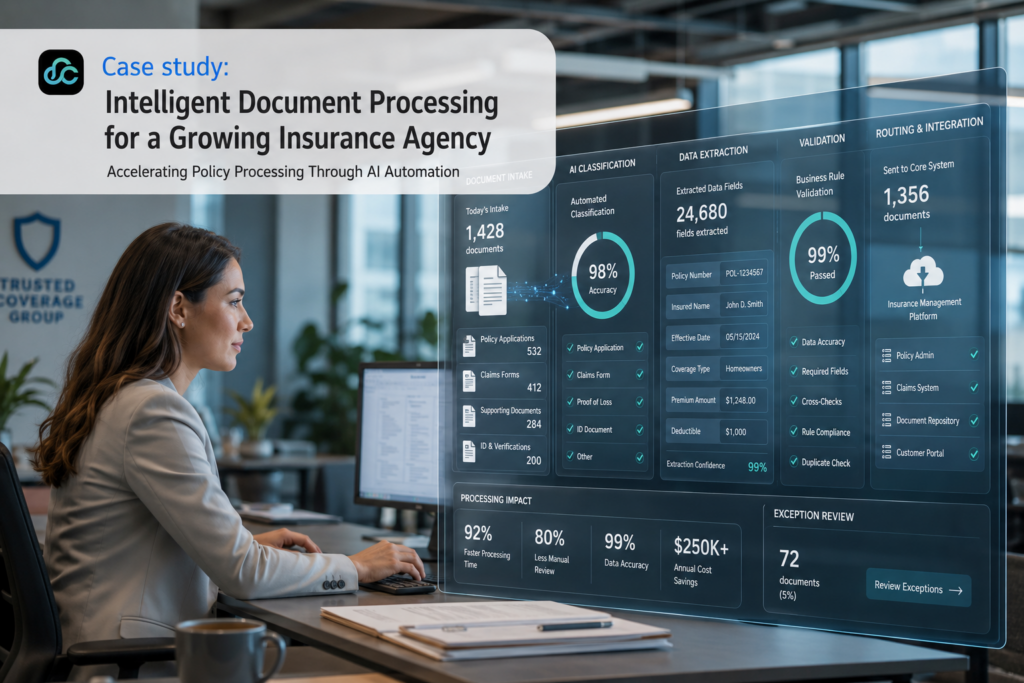
Intelligent Document Processing for a Growing Insurance Agency: Straight-Through Policy Handling at Scale
12%→71%
Policies Processed Same Day
Human Review
For Exceptions
Challenge
A rapidly expanding insurance agency in the Southwest faced a backlog of paperwork, leading to delays in policy processing, inaccurate data entry, and poor customer experience. The agency’s team was spending countless hours manually sorting, reviewing, and inputting data from various insurance forms, applications, and claims documents. This inefficient process not only slowed down their operations but also increased the risk of errors and omissions.
We delivered an intelligent document processing pipeline that classifies, extracts, validates, and routes incoming documents — with a human in the loop only where the model isn’t confident.
Solution
Documents are auto-classified by type on arrival, then parsed with a layout-aware extraction model tuned on the agency’s own historical corpus rather than a generic template set. Extracted fields are validated against business rules and cross-checked against existing records in the policy administration system; anything that reconciles cleanly is written straight through. Anything ambiguous is queued to a reviewer with the source document and the flagged field side by side, so review takes seconds rather than minutes.
Confidence thresholds are tunable per document type, which let the agency start conservative and widen the automation envelope as the model earned trust. The result is a back office that scales with volume instead of with headcount — and staff redeployed from data entry to client-facing work.
AI & IT CONSULTING
INSURANCE
Intelligent Workflow Automation — Manufacturing
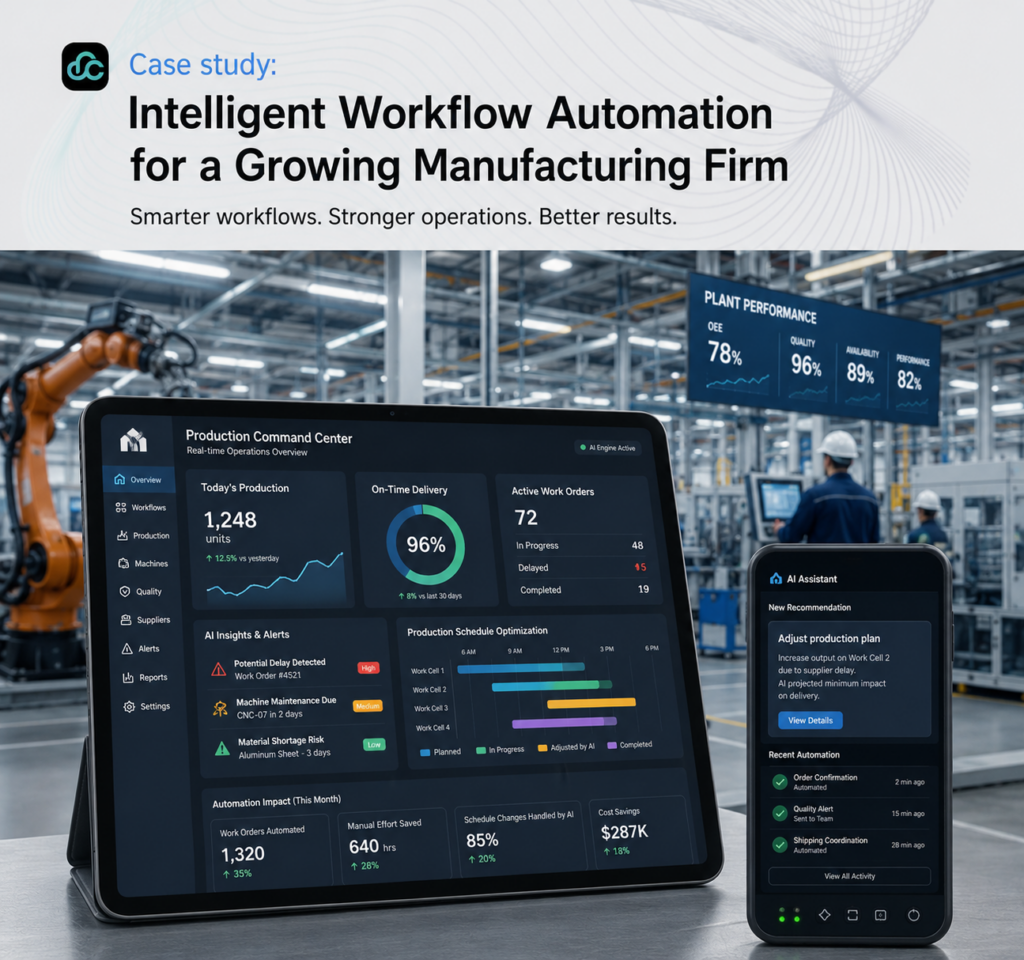
Intelligent Workflow Automation for a Manufacturing Firm: Production Scheduling That Adapts in Real Time
68%
Scheduling Tasks Automated
86%→94%
On-Time Delivery Rate
Challenge
Production planning relied on information from ERP, MES, and supplier systems. Changes in machine status, inventory, orders, or supplier commitments could leave the schedule out of date before the next planning cycle.
The team needed a way to surface scheduling risks early while keeping managers in control as conditions changed.
Solution
We implemented an AI workflow orchestration layer that sits across their ERP, MES, and supplier systems and turns production planning from a weekly ritual into a continuous, adaptive process.
The scheduling engine ingests live signals — machine status, inventory positions, order priority, supplier commitments — and re-optimizes the production plan as conditions change, rather than requiring a human to notice and react. Routine transactions (order confirmations, shipping coordination, exception alerts) are automated end to end. Emerging risks are surfaced before they become late shipments, with the specific recommended action attached.
We deliberately kept humans in control of the decision, not the data-gathering: managers approve or override recommendations rather than assembling them.
The integration was built read-first — we proved the model’s scheduling recommendations against historical outcomes before it was allowed to write a single work order.
AI & IT CONSULTING
MANUFACTURING
Product engineering
Nurse Shift Management Platform — Enterprise Healthcare
Nurse Shift Management Platform for Enterprise Healthcare: Compliant Scheduling for 100,000+ Clinicians
Challenge
A national healthcare organization was scheduling a workforce of 120,000 nurses across 340 facilities with tools that were never designed for that scale.
Shift assignment was effectively manual, and no single view existed of who was available, who was approaching a daily hour limit, or which facility was short. Compliance rules — daily maximums, mandatory rest, credential validity — were enforced by staff memory and after-the-fact audit, which meant violations were discovered rather than prevented. Overtime and agency-staffing costs ran into the tens of millions annually, much of it avoidable.
Under peak scheduling load, the incumbent system degraded: 800 requests per minute was enough to slow assignment to a crawl at exactly the moment coordinators needed it most.
Solution
The platform holds real-time scheduling state for 100,000+ concurrent nurses and sustains 3,200 requests per minute at peak, on a horizontally scalable architecture with the read and write paths separated so that reporting load can never starve assignment.
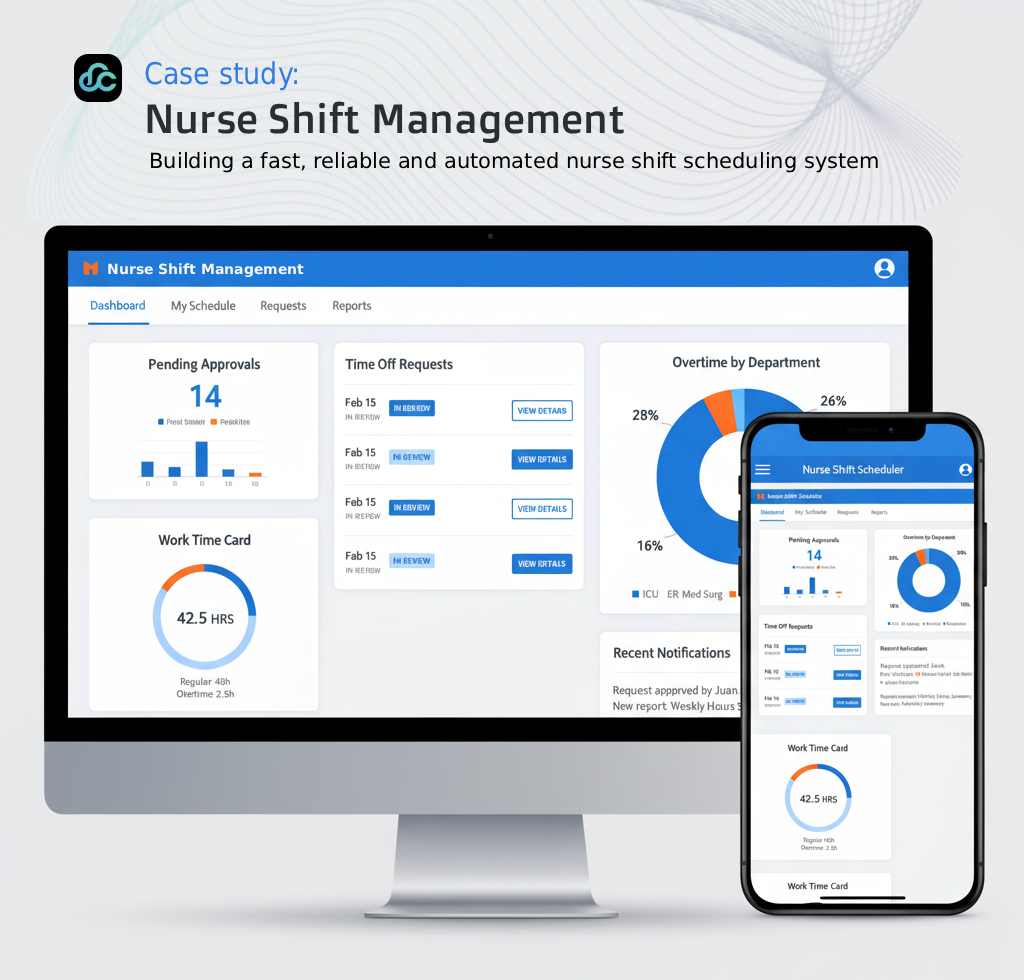
100K+
Nurses in real time
3,200
Peak Throughput request /min
Cloud Solutions
AWS Landing Zone — Healthcare Providers
AWS Landing Zone for Healthcare Providers: HIPAA-Ready Cloud Foundations, Compliant on Day One
Challenge
A healthcare provider network needed to run mission-critical clinical applications in the cloud while protecting PHI across 14 business units — and their existing setup could do neither reliably.
Environments were provisioned by hand, which meant no two looked alike. Standing up a new workload took 12 days and a series of tickets. Identity and access were managed per-account with no central audit trail, so answering a basic compliance question — who can reach this data, and who did — took 4 days of manual evidence gathering. Security baselines drifted, because nothing enforced them.
Every new digital health initiative inherited that uncertainty before it wrote a line of code.
Solution
We engineered a dedicated AWS Landing Zone with healthcare guardrails baked into the foundation, so that compliance is the default state of a new environment rather than a project that follows it.
Account provisioning is fully automated through infrastructure-as-code: a new workload environment arrives pre-configured with encryption, logging, network segmentation, and HIPAA-aligned controls already in place. Identity, access control, and auditing are centralized across every account, so the who-can-reach-what question has a single authoritative answer. Dev, Test, and Production are standardized and governed identically, which removes the class of incident where something worked in test and failed in prod because the environments quietly diverged.
Monitoring and security baselines are enforced continuously — drift is detected and remediated, not discovered at audit.
The provider network now ships digital health workloads onto a foundation that is secure, predictable, and boring. In regulated healthcare, boring is the goal.
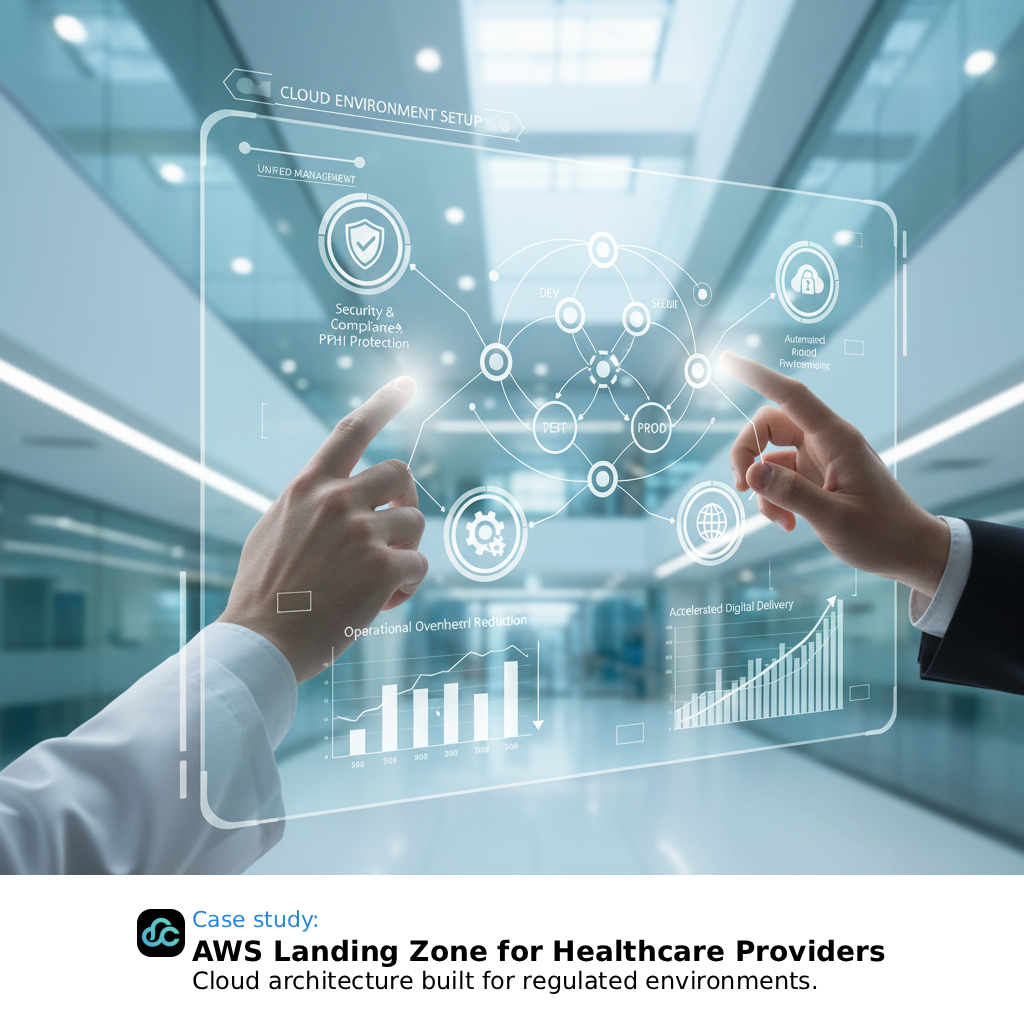
12 days→35 min
Environment Provisioning
↓ 82%
Audit Evidence Preparation
Product Engineering
Cross-Border Remittance Platform — FinTech
Scaling Cross-Border Remittances: A Unified Platform for Faster Settlement and Automated Compliance
Challenge
A North American financial institution was moving high volumes of cross-border remittances through a patchwork of point-to-point integrations, one per corridor, each with its own file format, its own compliance quirks, and its own failure modes.
Settlement took 3 days. Traceability was partial: when a transaction stalled, answering “where is this money right now” meant querying 7 systems and reconciling by hand. Reconciliation consumed 38 hours per week. KYC and sanctions screening were largely manual, which capped throughput and introduced exactly the kind of inconsistency regulators ask about.
Each new corridor took 10 weeks to launch — which made geographic expansion an engineering problem rather than a commercial decision.
Solution
We designed and built a Remittance Management Platform that collapses every corridor into one standardized integration layer, with web and mobile applications on top.
A unified API abstracts corridor-specific behavior behind a single transaction model, so adding a new market becomes configuration rather than a new integration project. Compliance and KYC validation are automated into the transaction flow — screening, verification, and decisioning happen inline, with full decision provenance retained for regulators. Reconciliation runs continuously against ledger and partner records instead of in a batch at the end of the day, so breaks surface within minutes.
Every transaction carries an end-to-end audit trail. “Where is this money” is now a lookup, not an investigation.
The platform was built for the corridors they wanted next, not just the ones they had.
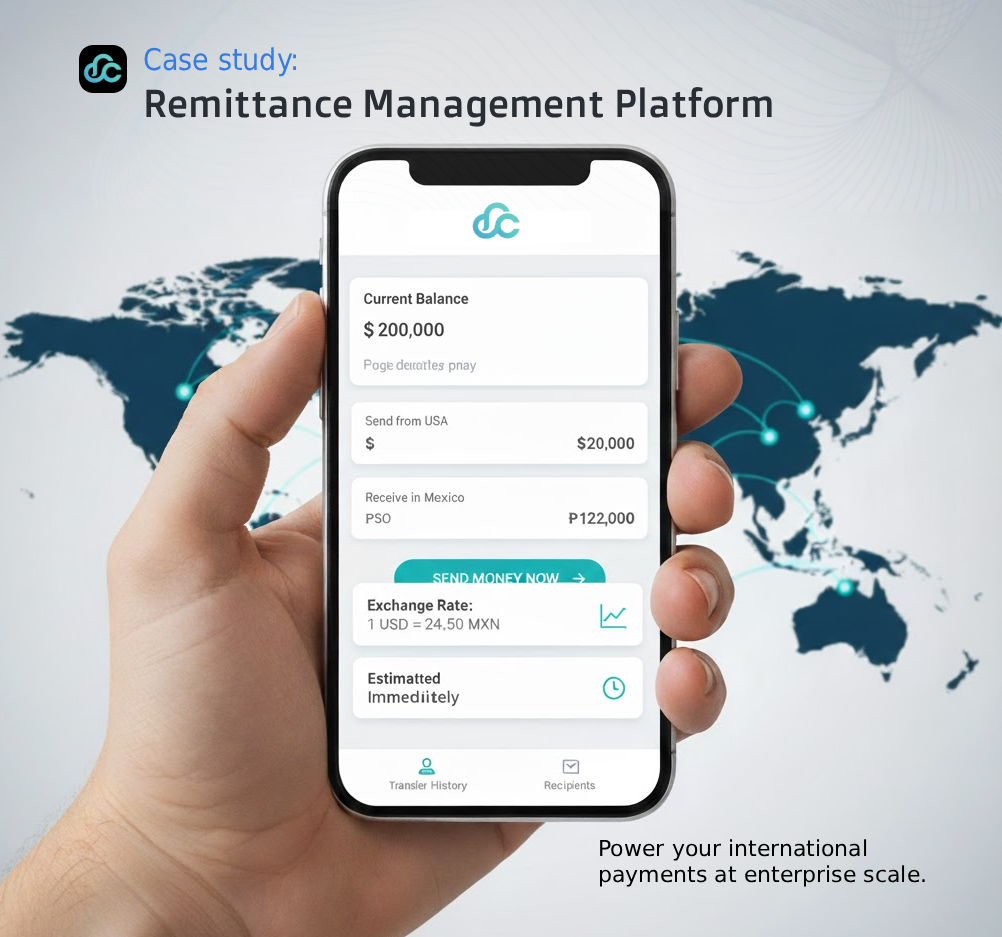
3 days→6 hrs
settlement cycles
10 wks→2 wks
Time to Launch a New Corridor
Cloud Solutions
Azure Cloud Foundation — FinTech
Secure Azure Cloud Foundation for FinTech: Policy-Driven Governance and Zero-Trust from Day One
Challenge
A fast-growing FinTech needed a secure, scalable, and compliant cloud foundation to support new digital products and high-volume transactions. Their existing environment lacked standardization, governance guardrails, and the deployment automation required to scale confidently across regions.
Solution
A fast-growing FinTech was shipping new digital products onto a cloud environment that had grown organically — and was now the main thing slowing them down.
There was no standardization: environments were configured by whoever built them, which made every deployment a small act of archaeology. Provisioning a new environment took 9 days. Governance was advisory rather than enforced, so security posture depended on individual discipline; 42 misconfigurations were surfacing per month in review. Releases went out 4 times per month, constrained not by product readiness but by the manual work of preparing infrastructure.
For a company operating under financial regulation, “we think it’s configured correctly” is not an acceptable answer.

4/mo → 22/mo
Deployment frequency
↓ 87%
Misconfiguration findings
140+
automated security policies
Product Engineering
Warehouse Management Platform — Enterprise Logistics
Warehouse Management Platform for Enterprise Logistics: Real-Time Inventory Control Across Every Distribution Center
Challenge
A logistics operator running 18 distribution centers had no single, current answer to the simplest question in the business: what do we have, and where is it?
Inventory accuracy sat at 91.8%, which meant stock was counted, doubted, and counted again. Inbound and outbound processes were paper-driven and error-prone. Replenishment was reactive — triggered by a stockout rather than by a forecast — producing 64 stockout events per month alongside overstock sitting in the wrong building.
Order fulfillment took 11 hours end to end, and scaling to meet demand meant scaling the errors too.
Solution
We designed and built a Warehouse Management Platform that automates the physical workflow and gives operations a single, live view of inventory across every location.
Inbound and outbound processes are automated end to end — receipt, putaway, pick, pack, dispatch — with scanning and system validation replacing paper and recall. A predictive analytics engine forecasts demand per SKU per location and drives replenishment before a stockout occurs rather than after, and rebalances stock across DCs based on where it will actually be needed.
An integration layer connects the platform to their existing transport and ERP systems, so the warehouse stopped being an island in the logistics chain.
Operations dashboards expose fulfillment performance in real time, which is what turned inventory management from a reporting exercise into a control system.
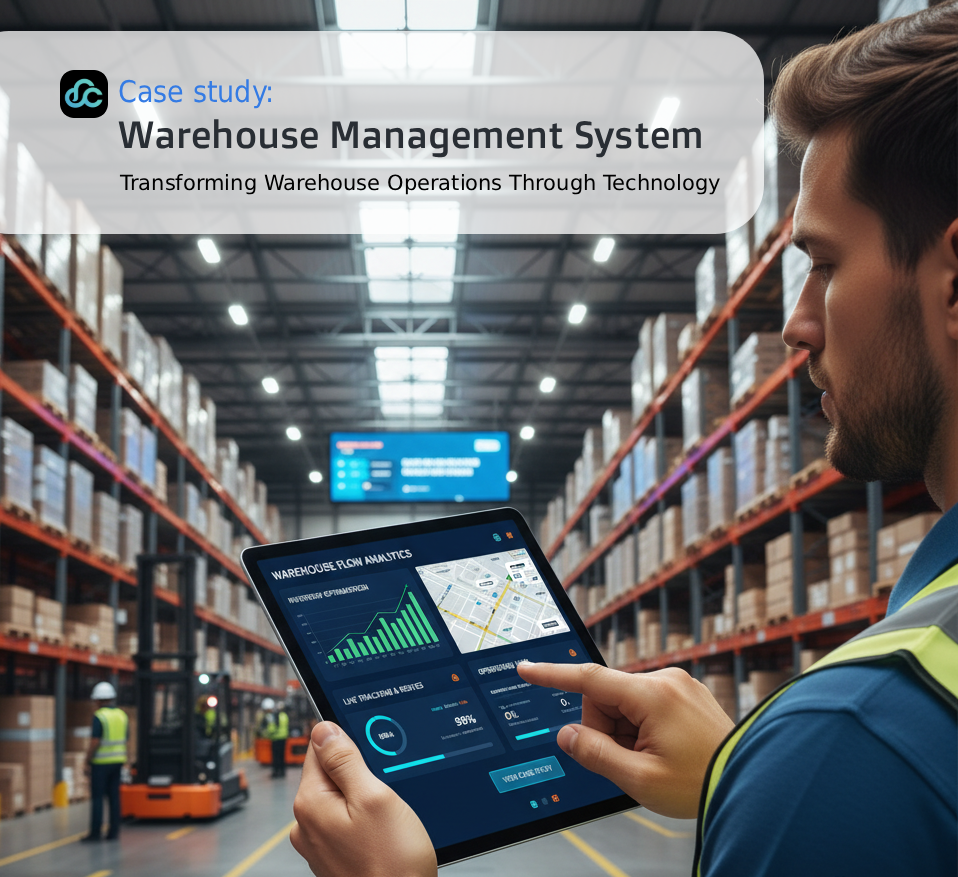
↓58%
Order Fulfillment Time
↓71%
Stockout Events
Product Engineering
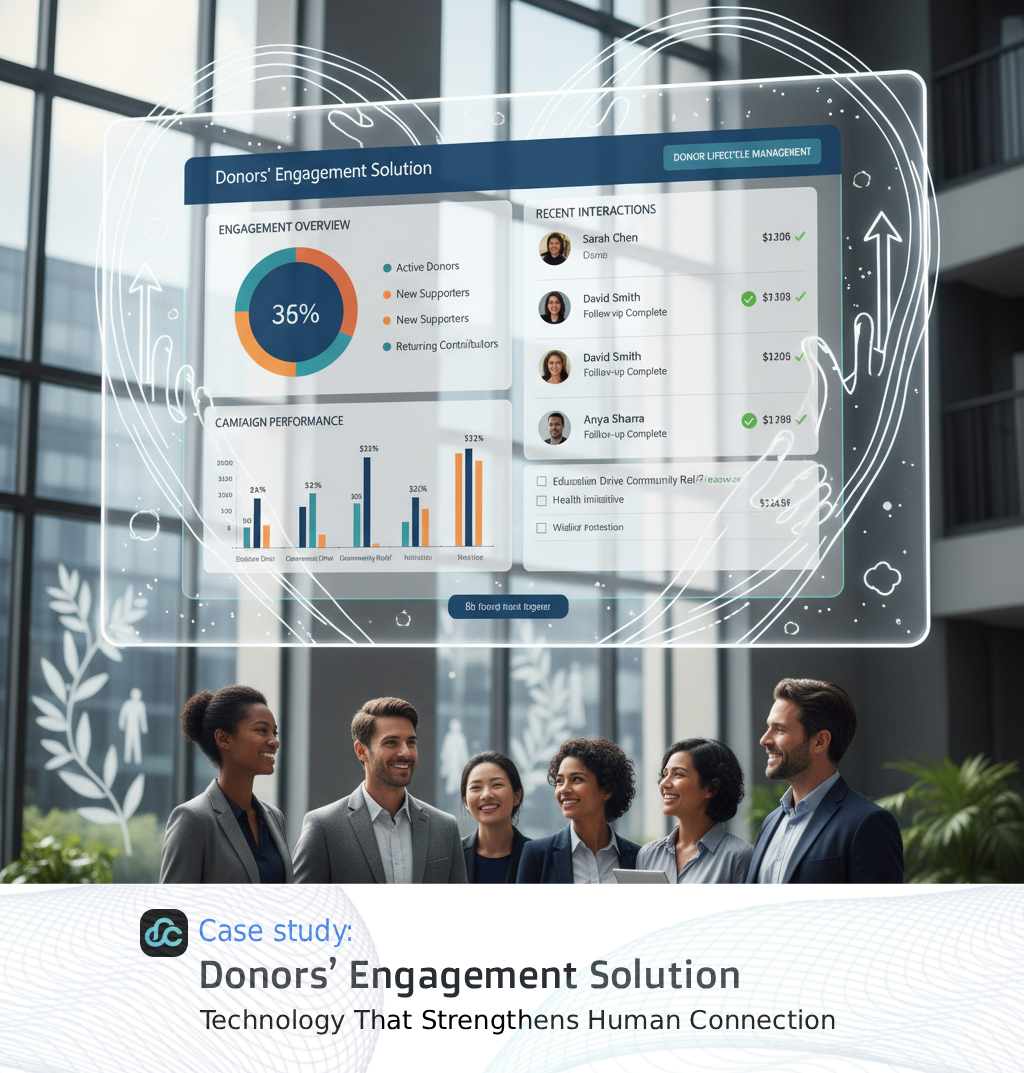
Donors’ Engagement Solution for a Global Non-Profit
Donor Engagement Platform for a Global Non-Profit: Personalized Giving Journeys, Backed by Real-Time Data
Challenge
A global non-profit was fundraising across 22 countries with donor data spread across 9 disconnected tools, none of which agreed with the others.
Nobody could see a donor’s full journey. Segmentation was done by hand in spreadsheets, so campaigns were coarse: the same appeal went to a first-time $25 giver and a decade-long major donor. Campaign coordination was manual and performance data arrived 5 days after the fact — too late to change anything while it mattered. Donor retention sat at 48%, and the cost of acquiring a replacement donor was several times the cost of keeping an existing one.
Meanwhile, transparency and data-protection expectations from donors and regulators were rising in every region they operated in.
Solution
We built a donor engagement platform that unifies donor intelligence, personalized communication, and real-time analytics into a single connected system.
A unified donor data model brings campaigns, giving history, and every interaction into one record, which is the prerequisite for everything else. Predictive segmentation identifies who is at risk of lapsing and who is ready to give more — and AI-assisted automation delivers the right message, on the right channel, at the right moment, without the fundraising team hand-building each send.
Web and mobile applications give donors a transparent view of where their money goes, which is increasingly the price of entry for sustained giving.
A real-time analytics layer shows campaign performance while the campaign is still running. The architecture is built for global operation: regional data residency, consent management, and auditability handled at the platform level.
48%→63%
donor retention rate
↑34% YoY
Recurring Giving Growth
AI & IT Consulting
AI Opportunity Assessment — From Uncertainty to Measurable Impact
From AI Uncertainty to Measurable Business Impact: An AI Opportunity Roadmap That Ships in 30-60-120 Days
Challenge
A services company had AI on the executive agenda and no idea where to point it. Teams had launched 11 separate AI pilots; none had reached production, and none had a number attached to it.
The failure wasn’t technical. It was that nobody had connected AI capability to an actual operational bottleneck — so effort went to whatever demoed well rather than to whatever cost the business the most. Leadership was being asked to fund a portfolio it couldn’t evaluate, and the honest answer to “what’s the return on this” was that no one knew.
The team was spending 186 hours per week on manual work that a targeted intervention could have removed months earlier.
Solution
We ran a structured AI opportunity assessment that starts with the operation, not the technology.
We mapped the company’s real workflows and quantified where time, cost, and error actually accumulate — then scored candidate AI interventions against effort, data readiness, and modeled financial return. That produced a prioritized 30-60-120 day roadmap: what to build now, what to build next, and — just as valuable — what not to build.
We then built working prototypes against the highest-value use cases, in weeks rather than quarters, so the ROI case was proven with real data on real workflows before anyone committed to a production budget.
The deliverable wasn’t a strategy deck. It was a shortlist of validated, measurable bets and the architecture to scale the winners.
↓61%
Manual task
18 days
Time to First Working Prototype
Product Engineering
Custom CRM Platform — Built for Any Business Model
Challenge
Off-the-shelf CRMs ask companies to adapt their process to the tool. For most organizations, that trade is invisible until it’s expensive.
The pattern we kept seeing across clients: teams paying $1,650 per seat per year for a platform where 68% of the feature set went unused, while the workflows that actually mattered to their business had to be forced into a data model that wasn’t built for them. Critical customer information ended up in 6 systems outside the CRM because the CRM couldn’t hold it. Sales cycles ran 17 days longer than they needed to, because handoffs between customer experience, sales, and operations happened over email.
Configuration had reached its limit. What was needed was a different starting point.
Solution
We built our own CRM — web-based, mobile-ready, API-first — designed to be shaped around a company’s operating model rather than the other way around.
Processes are customizable end to end: stages, objects, rules, and permissions map to how the business actually works, including the parts that don’t fit a standard sales funnel. Workflows are automated across customer experience, sales, and operations, so a handoff is a state transition rather than an email. A centralized data layer gives every team the same real-time view of the customer, and AI-assisted features surface next-best actions and remove the data-entry tax that kills CRM adoption in the first place.
The API-driven architecture means it integrates with what a company already runs, rather than demanding they replace it.
Adoption is the metric that matters for a CRM, and adoption follows from a tool that fits.
↓ 29%
Lead-to-Close Cycle Time
6 tool→1 platform
System Consolidated
AI & IT Consulting
Predictive Market Intelligence Engine
Building Predictive Market Intelligence: Turning Fragmented Data into Faster, More Confident Decisions
Challenge
Leadership teams were making market decisions on evidence that was already out of date by the time it reached them.
Data lived in 14 separate sources — internal systems, market feeds, competitor signals, third-party research — and nobody had reconciled them. Analysts spent 72 hours per week collecting and cleaning rather than analyzing, and a single market question took 8 days to answer. Forecast accuracy ran 56%, which is another way of saying that plans were being built on a coin flip.
The competitive cost is subtle but compounding: the organization was consistently reacting to shifts that a faster read would have let them anticipate.
Solutions
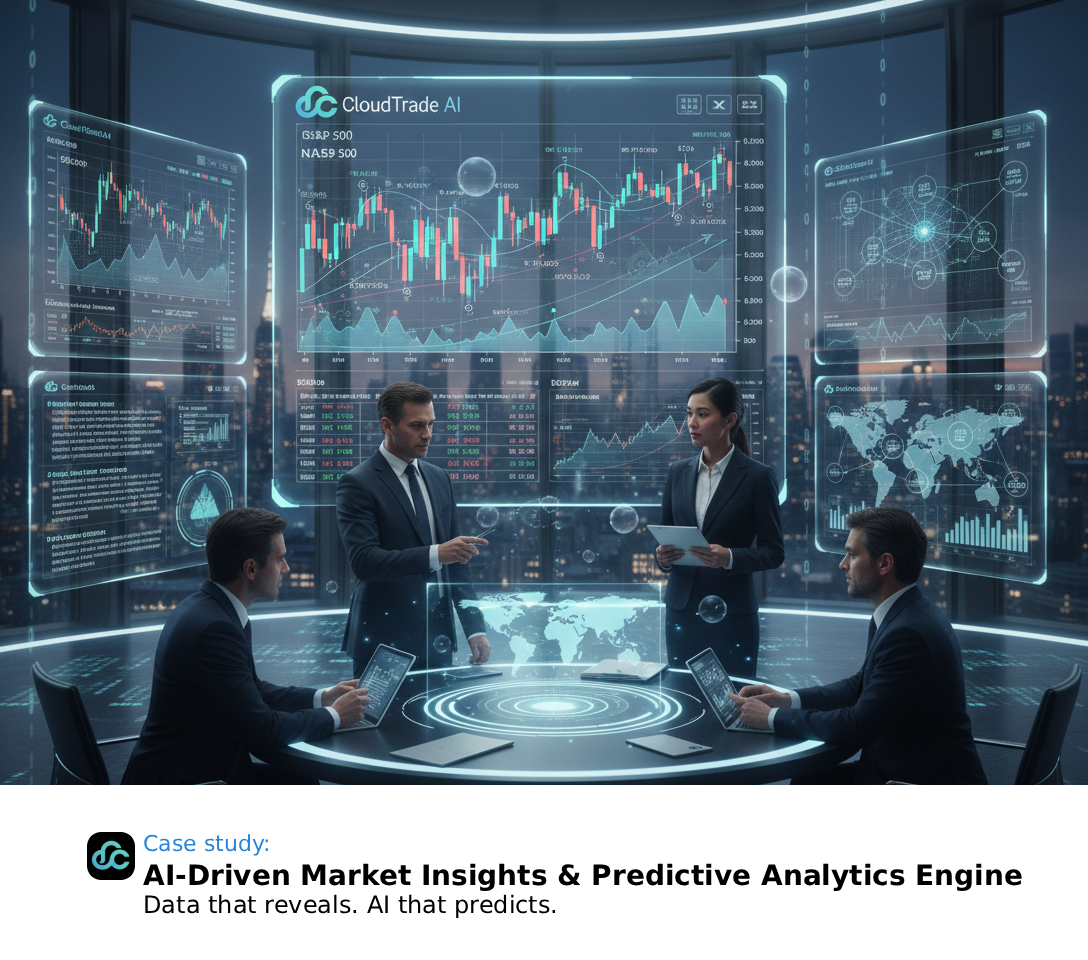
We built an AI-powered analytics engine that consolidates fragmented multi-source data and converts it into forward-looking, decision-ready intelligence.
Internal, market, and third-party sources are unified into a single governed data model with lineage retained, so any insight can be traced back to its evidence — which is what makes executives willing to act on it. Predictive models forecast trends, risk, and market behavior rather than restating what already happened, and AI-generated insights are written for the decision, not for the analyst.
Analysis workflows that used to be a manual research cycle now run automatically and refresh continuously.
Executive dashboards deliver a real-time market picture, so leadership walks into a decision with a current view rather than a reconstruction of last quarter.
56%→78%
Forecast Accuracy
14 Sources→1 model
Data Sources Unified